John Irwin - Astronomical Software Developer |
| I am a scientific programmer from England with experience in computational astronomy, scientific data analysis, and 3D computer graphics. My particular expertise is in the fields of positional astronomy and celestial mechanics, and in the application of high-performance visualisation techniques in these particular areas. |
| I have a BSc in Physics and Astronomy from the University of Leicester (1986), a Postgraduate Diploma in Experimental Nuclear Structure Physics from the University of Manchester (1988), and an MSc in 3D Computer Graphics and Visualisation from the University of Teesside (1992). |
 |
| In more recent years I have taken a keen interest in developing software for the analysis and visualisation of solar eclipses. Highlights include: |
|
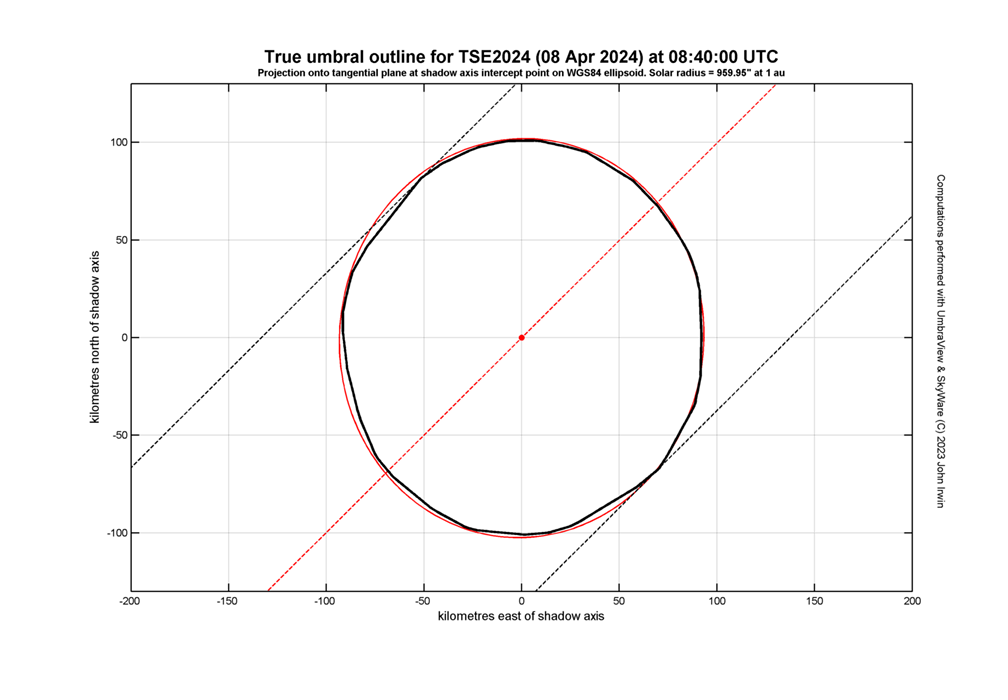
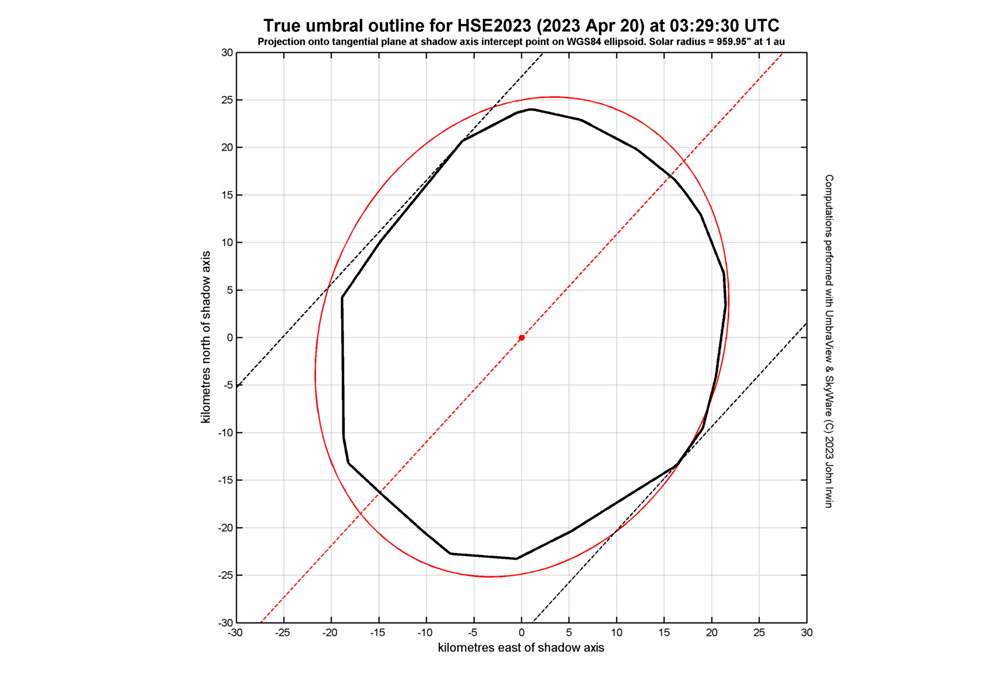
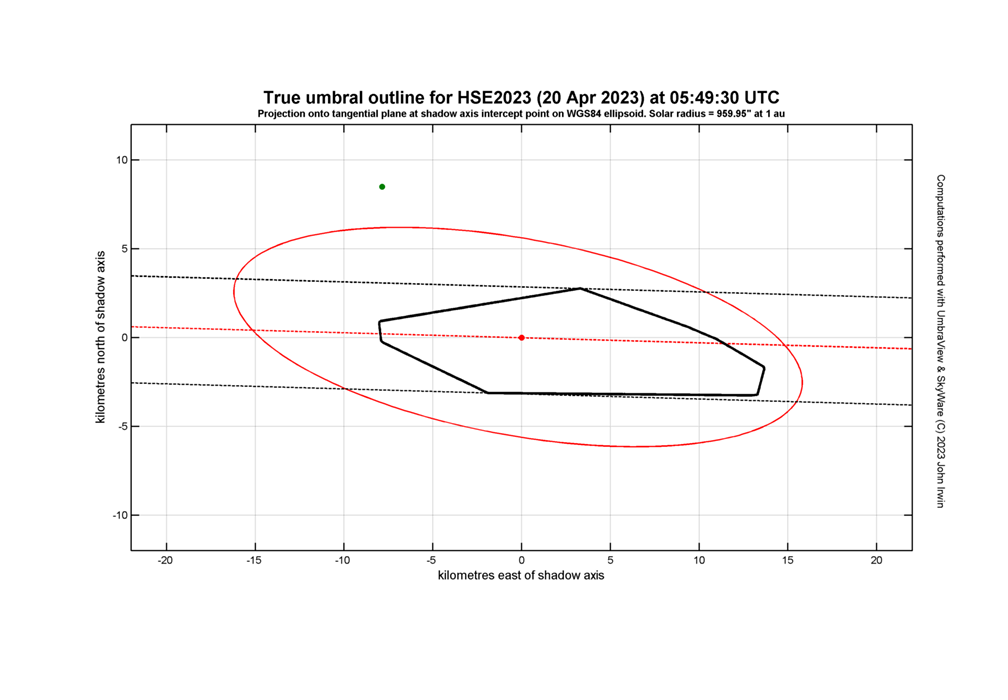
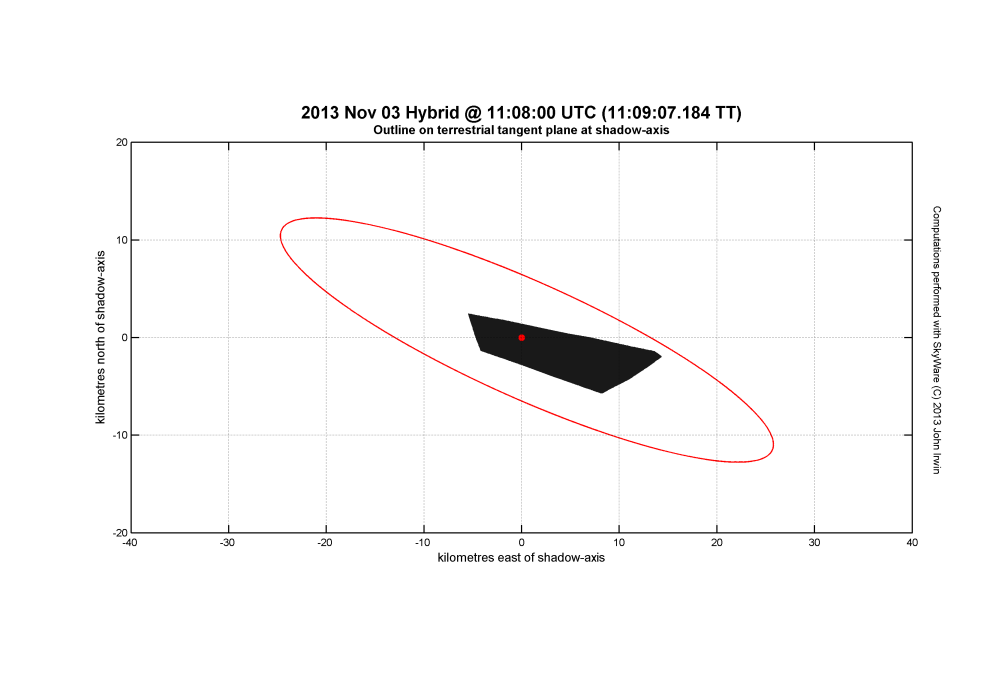
A: The development of a novel shadow projection technique to compute the umbral outline for a solar eclipse that directly allows for the true shape of the lunar limb. This new algorithm can provide accurate and robust contact-time predictions for any observer and, if required, the position of the true umbral path limits which is more reliable than anything that has been done defore. The computations are performed with UmbraView, an interactive graphics application for the visualisation of the true umbral outline and its motion with respect to a given observer. See for example: TSE2024, HSE2023, HSE2023, HSE2013 |
B: The computation and visualisation of the true umbral and antumbral surfaces of the lunar shadow. This work extended the shadow projection technique to provide a means of delineating the true shape of the Moon's shadow in 3D space. It revealed a marked deviation from the traditional view of the shadow as a pair of touching circular cones, with the result that a substantial gap opens up around the shadow cone apex. This new discovery explained why the e-flight observations at the hybrid eclipses in 1986 and 2013 failed to see totality when predictions made at the time indicated they would fly through the Moon's umbral cone and observe the Sun's disk fully occulted by the Moon. True Umbral and Antumbral Surfaces of the Lunar Shadow |
|
C: The creation of the Thirty Millennium Catalog of Solar and Lunar Eclipses, derived from JPL's long-term DE441 planetary ephemerides, supported by Vondrak's very-long-term precession model and IAU2006 nutation. The catalog is the longest and most accurate of its kind and provides tables of predicted data for 71264 solar eclipses and 72272 lunar eclipses between the years -13000 and +17000, including detailed Besselian elements for every solar eclipse. Thirty Millennium Catalog of Solar and Lunar Eclipses (3rd Ed) |
D: The creation of a set of illustrative video animations depicting the evolution of shadow cone outlines on the surface of the Earth for various contemporary solar eclipses. The animations were created with EclipseView, an interactive 3D application developed for the visualisation of eclipse phenomena associated with any three-body alignment in the Solar System. The Illustrated Eclipse of the Sun |
| Both EclipseView and UmbraView rely upon a software library called SkyWare as their main computational engine. SkyWare has been in development since about 2005 and provides a sophisticated but easy-to-use API for performing high-quality computations in positional astronomy and the generation of ephemerides for a wide range of celestial objects. The SkyWare API was also instrumental in the computation of the thirty millennium catalogs of eclipses. SkyWare API Summary (PDF) |
| I saw my first eclipse from the front door of my childhood home in May 1975. It was a large partial in the early morning sky which I dutifully recorded in pen and ink but have since lost contact with the evidence. I have seen a few more partial eclipses since then but have only once attempted to see totality. That was from south-west England in August 1999 under a rather cloudy sky which prevented a clear view of the eclipse and the full majesty of the event was denied me. However, the cloudiness made this a particularly dark eclipse on the ground and the horizon out over the sea acquired a very deep orange colour. I also noted that the ambient light levels in the last few seconds before second contact dropped in a very irregular way, almost in a step-wise fashion, which has remained a puzzle to me ever since (but could just be an effect of Baily's beads). I hope that my next attempt to immerse myself in the umbra is more successful and is not too far away, in either time or space. |
| More Eclipse Projects | More Graphics Projects |
| Last updated 11 December 2023 |