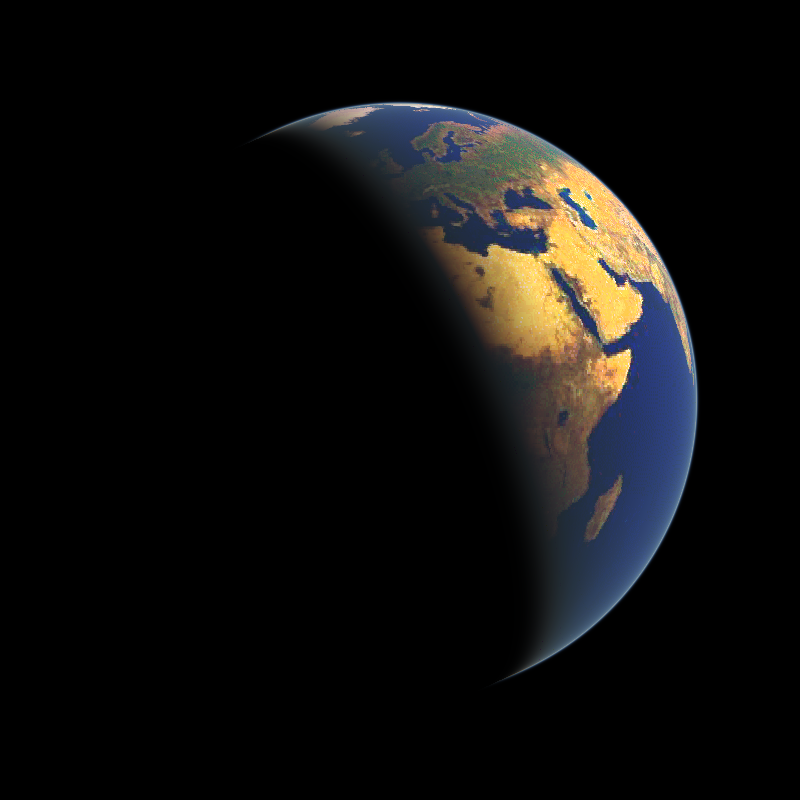
Rendering the Earth's AtmosphereThe work described here has attempted to simulate views of the Earth's atmosphere by considering the scattering and absorption of light in a spherical, gaseous envelope whose density diminishes exponentially with height above the ground. The envelope consists of pure air extending from a radius of 6371 km to a height of 200 km and the change in density with height is represented by a scale height of 8.4 km. Beyond 200 km we assume a vacuum. For pure air we assume a single scattering model and Rayleigh parameters for the scattering coefficient and phase-function. Numerical integration of the radiative transfer equation for this simplified situation is used to calculate radiances leaving the atmosphere.The Earth's shadow is taken into account when we determine the light paths through the atmosphere, and since we are also assuming a parallel light source to represent the radiation from the Sun, the shadow is modelled as a cylinder, with a radius equal to the Earth's radius, extending from the Earth's centre in a direction away from the Sun. The Earth's surface itself is modelled as a texture mapped sphere of radius 6371 km. The texture map is a composite satellite image of the cloudless Earth. For calculating radiances reflected from the surface, we have assume a simple diffuse reflection model. The program used to generate the images can produce views from any desired point and in any direction. We will start with some pictures of the Earth and its atmosphere as seen from space. |
Views from outside atmosphere
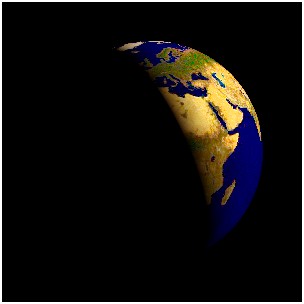
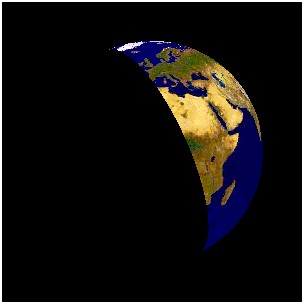
On the left is a preview image showing the texture map of the Earth's
surface and the orientation of the Sun's illumination. An image like this
can be computed very quickly, which is useful in setting-up interesting
views. The image is a 4° view of the Earth from 240,000 km above the
equator at longitude 0° and the Sun is over-head at latitude 23°N,
longitude 110°E. This corresponds to Midsummer in the northern hemisphere.
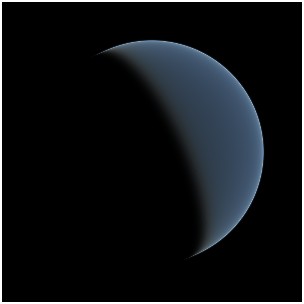
The image on the right shows how the Earth's surface looks when we ignore
scattering in the the atmosphere and only absorption is considered. Notice
the reddening around the North Polar ice cap resulting from long light
paths.
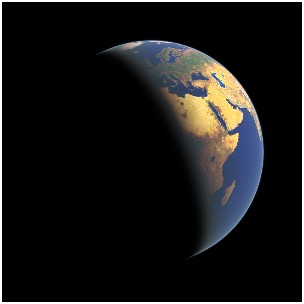
In the image on the left we see only the light scattered by the atmosphere itself. We can now clearly see the the effects of the Earth's shadow -- light is reaching parts of the atmosphere on the dark side of the Earth, beyond the terminator as indicated in the first image. Finally, in the right-hand image we consider all light scattering, absorption and reflection from the Earth's surface together. A full-size, full-colour, version of this image is available (161k).
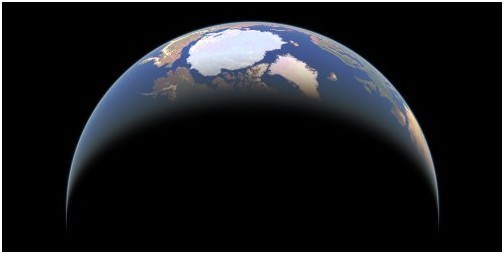
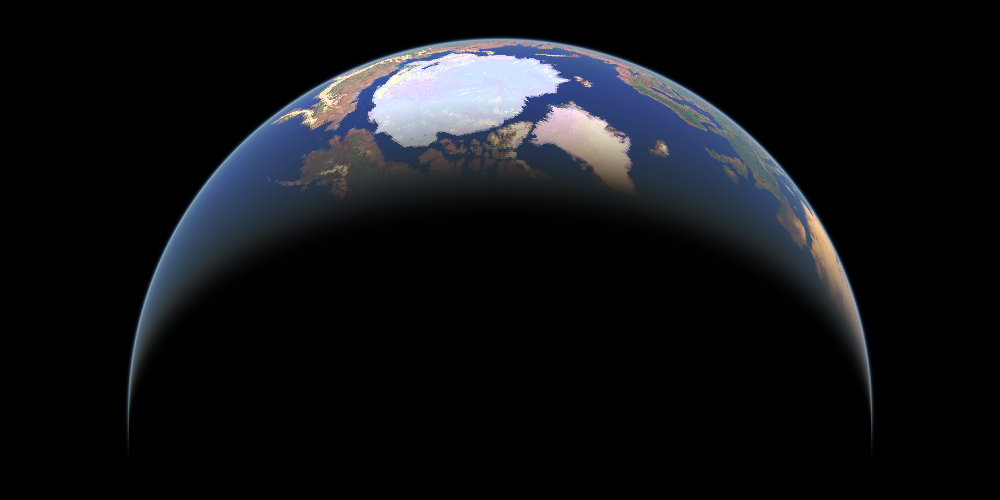
This a another view of the Earth and its atmosphere, again from 240,000 km above the surface. The view point is directly above 30°N, 90°W looking at a point on the surface at 55°N, 90°W. The Sun is overhead at 23°N, 90°E. A full-size, full-colour, version of this image is available (149k). |
Views from inside atmosphereThe next set of images show views from within the Earth's atmosphere. Since we are now very close to the surface, the surface texture map has been removed because there is not enough resolution to depict fine terrestrial detail. Only the light from the atmosphere itself is shown.
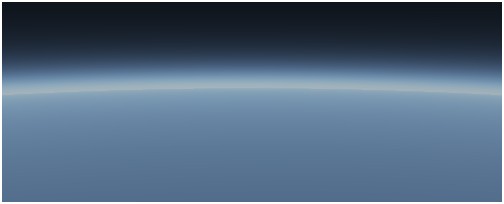
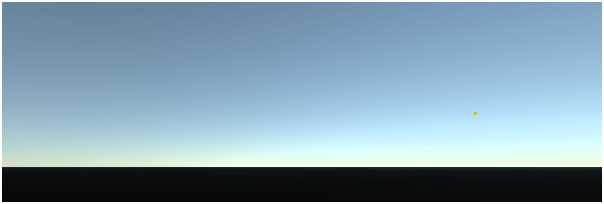
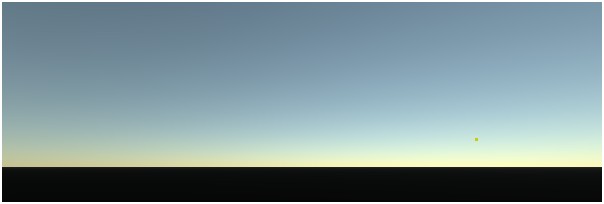
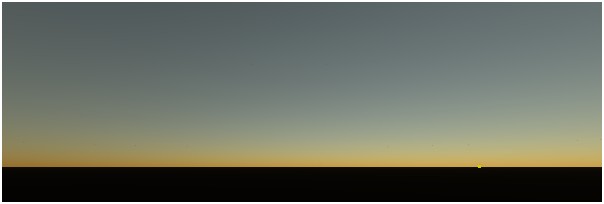
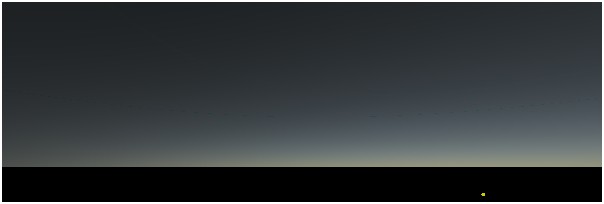
This image is a view of the Earth from a height of 50 km looking out towards the horizon. The view point is still sufficiently high enough to show the Earth's curvature. Below is shown a sequence of 90° (horizontally) views of the setting Sun from 2 m above the Earth's surface. The Sun's position in each image is indicated by the yellow disc (for display purposes only, though the size is correct) at approximately 10°, 5°, 0°, -5° and -10° from the horizon, respectively. When the Sun is below the horizon the view point is actually inside the Earth's shadow, so we see less illuminated atmosphere and thus less intensity from the sky, as expected.
|
Ideas for further workThere are at least two significant problems remaining with the model thus far described. The first concerns skylight reflected from the Earth's surface. As the model stands at the moment the surface is only illuminated directly from the Sun. In reality, the surface is also illuminated from a secondary source of light which comes from all of the atmosphere in the hemisphere above each point on the surface: this is skylight. Skylight is a diffuse form of lighting, dependent on the position of the Sun in the sky as seen from the surface, which would not be easy to calculate using the ray-tracing rendering technique developed here. The ideas from distributed ray-tracing would be of value here.The other problem is evident in the sunset images shown previously, especially those with the Sun on or below the horizon. We can see that there is a distinct lack of blue colour in the sky when in reality the sky remains quite blue (though of a different quality) long after sunset. There are two effects at work here which the model does not address: multiple-scattering and ozone absorption, of which the latter has its most noticable effect on the sky colour after sunset. Incorporating multiple-scattering is fraught with computational problems, which in all honesty should be dealt with using other rendering techniques. However, because we are at the moment only concerned about scattering in pure air (an optically thin medium), the development of a double-scattering light model may be a good compromise. The incorporation of ozone absorption would be fairly easy, as a spherical shell of constant density with an appropriate height and thickness in the atmosphere. Finally, it would be interesting to include the effects of refraction in our model. Then we may be able to simulate such effects as the flattening of the Sun's disc at sunset and the green-flash phenomenon, which is thought to be caused by dispersion in the Earth's atmosphere. And, of course, it would be nice to add some clouds, but that's another story! Full-Spectral Rendering of the Earth's
Atmosphere using a Physical Model of Rayleigh Scattering
|