Mapping the Broken Solar Eclipse |
| All hybrid eclipses, as well as a number of marginal annulars, exhibit broken phases along some sections of their central paths. It is not an easy task to map these sections in precise detail, but due to the narrowness of the path, we can still get a reasonable picture of their extents by concentrating on the eclipse state as it pertains to the central line. This makes it relatively straightforward to extract the necessary data. |
| The table below summarises the results of such an analysis for all hybrid eclipses between 1894 and 2031, plus two examples of annulars within the same interval that may be particularly familiar to verteran observers who had expected to see annularity back then (Greece 1966 & USA 1984). Entries are ordered according to their degree of brokenness, defined here as the fraction of the whole topocentric central line that contains a broken eclipse. |
| Follow the links to download KML files showing the distribution of the broken eclipse state along each central line. They can be viewed in Google Earth. Markers on the central line contain event information for all waypoints (click to display). Use the Google Earth sidebar as a guide. |
| Type1 is the nominal designation based on the mean lunar limb, while Type2 is the designation after taking into account the true lunar limb. The letters indicate the eclipse state at the start, middle, and end of the central line. The dash in a Type2 designation indicates a broken eclipse. The number in parentheses in the Broken column indicates whether the broken eclipse sections are contiguous or separated into two parts. |
| Eclipse | Saros | Type1 | Type2 | Central line [km] | Broken [km] | % |
|---|---|---|---|---|---|---|
| 1986 Oct 03 | 124 | ATA | – – – | 1817 | 1817 (1) | 100.0 |
| 1908 Dec 23 | 140 | ATA | A–A | 14114 | 7991 (1) | 56.6 |
| 1912 Apr 17 | 137 | ATA | A–A | 13733 | 6322 (1) | 46.0 |
| 1894 Apr 06 | 137 | ATA | A–A | 13285 | 6076 (1) | 45.7 |
| 1987 Mar 29 | 129 | ATA | A–A | 14460 | 6465 (1) | 44.7 |
| 1930 Apr 28 | 137 | ATA | A–A | 14128 | 6300 (1) | 44.6 |
| 1948 May 09 | 137 | ATA | A–A | 14425 | 5997 (1) | 41.6 |
| 1966 May 20 | 137 | AAA | A–A | 14620 | 5200 (1) | 35.6 |
| 2031 Nov 14 | 143 | ATA | ATA | 13617 | 4282 (2) | 31.4 |
| 1984 May 30 | 137 | AAA | A–A | 14703 | 3927 (1) | 27.0 |
| 2005 Apr 08 | 129 | ATA | ATA | 14177 | 3500 (2) | 24.7 |
| 1909 Jun 17 | 145 | ATA | –T– | 8516 | 1920 (2) | 22.5 |
| 2023 Apr 20 | 129 | ATA | –T– | 13810 | 2872 (2) | 20.8 |
| 2013 Nov 03 | 143 | ATT | –T– | 13610 | 2073 (2) | 15.2 |
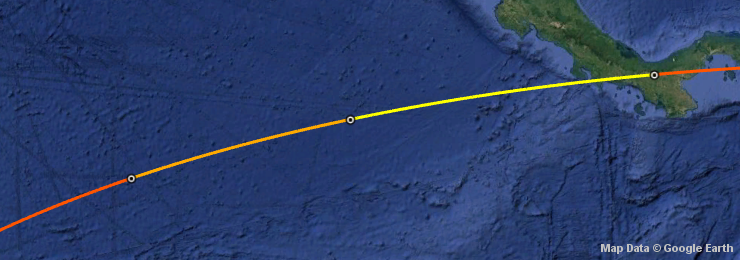
| Note that a broken eclipse comes in two varieties – broken-total or broken-annular – depending on which side of the mean-limb transition point it occurs. They are distinguished in the KML with different colours, as shown below for HSE2005 around the second transition zone. The middle marker locates the mean-limb transition point where the eclipse changes from broken-total (orange) to broken-annular (yellow). The markers on each side locate the true-limb transition points – true-total to broken-total on the left and broken-annular to true-annular on the right. |
 |
| It is common practise to describe any sort of broken eclipse as a "broken annular" but this does not always seem appropriate from the point of view of an observer on the ground. To see why, take a look at the topocentric views of the HSE2005 eclipse below, showing the appearance of the solar and lunar limbs from locations in the middle of the broken-total section (left) and in the middle of the broken-annular section (right). |
| The appearance of the eclipse on the left could hardly be called "broken annular" as it looks more like a total eclipse that has not quite achieved true totality. Only the eclipse on the right could be called "broken annular", i.e. an annular eclipse that has not quite achieved true annularity. Both views correspond to the time of maximum mean-limb eclipse on the central line and are as close to totality or annularity as they would get. |
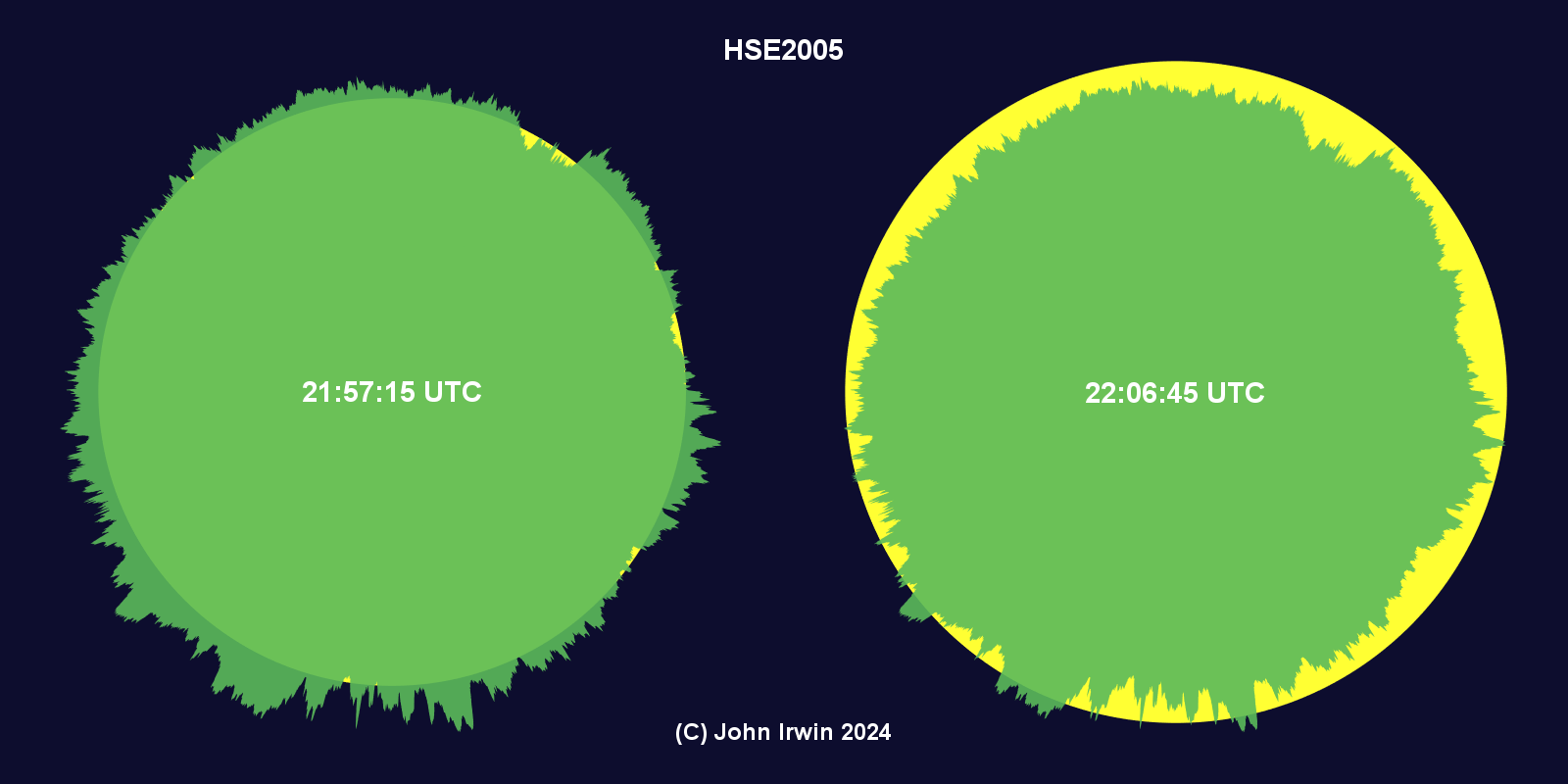 |
| Note that the solar and lunar limbs are exaggerated by a factor 50 relative to the mean lunar limb to highlight variation in the lunar limb profile. The effect of this is more prominent on the solar limb making it appear much larger in the annular phase than in the total phase. In reality the Sun's apparent radius has decreased by only 0.007" (and by only 2.3" for the Moon). However, relative to the (exaggerated) lunar limb, the degree of obscuration of the Sun depicted here is a true reflection of the eclipse state difference between these two views. |
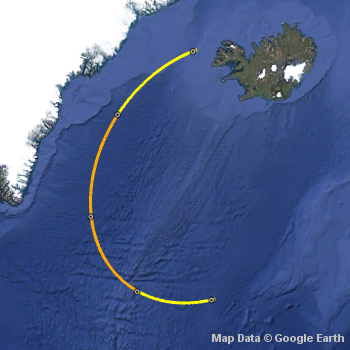
| As far as it is known, HSE1986 is unique in that the whole of its central line consists of broken eclipses (see below). In fact, the entirety of its short, narrow path is broken, not just on the surface of the Earth but also for a substantial distance above it. Read more about this here. |
 |
| A summary of the technical details forming the basis of these broken eclipse mappings: |
| Planetary ephemeris | JPL/DE440. |
| Astrometric method | Light-time + gravitational light deflection + planetary aberration. |
| Astrometric origin | Geocentric. |
| Earth orientation model | IAU2006A–EQX + EOP (where available). |
| Moon orientation model | ME421 (relative to PA440). |
| Mean solar radius | (696221 ± 36) km or (959.95 ± 0.05)" at one au. |
| Mean lunar radius | 1738.091 km. |
| Terrestrial radii | 6378.137 km, 6356.752 km (WGS84). |
| Lunar DEM | LDEM128 (128 pixels per degree). |
| Terrestrial DEM | None. |
| Software | UmbraView, EclipseView, LimbView & SkyWare (proprietary). |
| First published 20 October 2024 |
All media files © 2024 John Irwin